






















































-
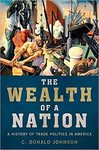
The Wealth of a Nation: A History of Trade Politics in America
Donald C. Johnson
The United States is entering a period of profound uncertainty in the world political economy--an uncertainty which is threatening the liberal economic order that its own statesmen created at the end of the Second World War. The storm surrounding this threat has been ignited by an issue that has divided Americans since the nation's founding: international trade. Is America better off under a liberal trade regime, or would protectionism be more beneficial? The issue divided Alexander Hamilton from Thomas Jefferson, the agrarian south from the industrializing north, and progressives from robber barons in the Gilded Age. In our own times, it has pitted anti-globalization activists and manufacturing workers against both multinational firms and the bulk of the economics profession. Ambassador C. Donald Johnson's The Wealth of a Nation is an authoritative history of the politics of trade in America from the Revolution to the Trump era. Johnson begins by charting the rise and fall of the U.S. protectionist system from the time of Alexander Hamilton to the Smoot-Hawley Tariff of 1930. Challenges to protectionist dominance were frequent and often serious, but the protectionist regime only faded in the wake of the Great Depression. After World War II, America was the primary architect of the liberal rules-based economic order that has dominated the globe for over half a century. Recent years, however, have seen a swelling anti-free trade movement that casts the postwar liberal regime as anti-worker, pro-capital, and--in Donald Trump's view--even anti-American. In this riveting history, Johnson emphasizes the benefits of the postwar free trade regime, but focuses in particular on how it has attempted to advance workers' rights. This analysis of the evolution of American trade policy stresses the critical importance of the multilateral trading system's survival and defines the central political struggle between business and labor in measuring the wealth of a nation.
-
International Civil Litigation in United States Courts (6th edition)
Gary B. Born and Peter B. Rutledge
International Civil Litigation in United States Courts is the essential, comprehensive law school text for the current and future international litigator or international corporate lawyer. Covering all the topics discussed in competing texts and more, this casebook seamlessly combines international litigation, conflict of laws, and comparative civil procedure. This Sixth Edition includes excerpts and updated discussion of recent U.S. court decisions and legislation relating to a wide range of private and public international law topics, including foreign sovereign immunity, choice of law, antisuit injunctions, legislative jurisdiction, service of process on non-U.S. citizens, international discovery, foreign judgment enforcement, and international arbitration.
-
Legitimacy and International Courts
Harlan G. Cohen, Nienke Grossman, Andreas Follesdal, and Geir Ulfstein
One of the most noted developments in international law over the past twenty years is the proliferation of international courts and tribunals. They decide who has the right to exploit natural resources, define the scope of human rights, delimit international boundaries and determine when the use of force is prohibited. As the number and influence of international courts grow, so too do challenges to their legitimacy. This volume provides new interdisciplinary insights into international courts' legitimacy: what drives and undermines the legitimacy of these bodies? How do drivers change depending on the court concerned? What is the link between legitimacy, democracy, effectiveness and justice? Top international experts analyse legitimacy for specific international courts, as well as the links between legitimacy and cross-cutting themes. Failure to understand and respond to legitimacy concerns can endanger both the courts and the law they interpret and apply.
- Experts in various fields analyse the meaning of legitimacy and its link to justice, democracy and effectiveness
- Features in-depth case-studies which outline the legitimacy challenges faced by international courts and offers lessons on how to approach them
- Will appeal to those seeking to deepen their understanding of legitimacy in the context of specific courts and across the field of international courts and tribunals
-
Arcs of Global Justice: Essays in Honour of William A. Schabas
Diane Marie Amann and Margaret M. deGuzman
Invoking famous words by Martin Luther King Jr.–‘the arc of the moral universe is long, but it bends toward justice’–this volume analyses developments respecting global justice in the decades since the end of World War II. Presented are dozens of essays by eminent scholars, each contributed in recognition of the collection’s honouree, Professor William A. Schabas. Schabas’s work has spanned many topics in international law and has placed him in multiple roles in international courts and organizations. Accordingly, this volume discusses institutions including the United Nations, the European Court of Human Rights, and the International Criminal Court, and instruments including the Universal Declaration of Human Rights, the Convention Against Torture, and the Canadian Charter of Human Rights and Freedoms. Fits and starts in global justice are examined with regard to many phenomena: peace and war, international crimes, culture, death penalty, environmental degradation, and not least, education and scholarship.
-

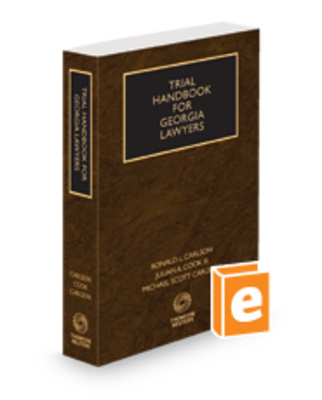
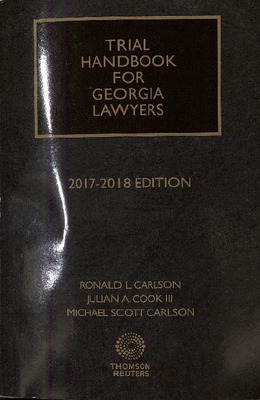
Trial Handbook for Georgia Lawyers, 2018-2019
Ronald L. Carlson, Julian A. Cook, and Michael S. Carlson
Examines Georgia-specific issues faced daily by trial attorneys, and analyzes the latest Georgia caselaw, rules, and statutes, with proper authorities cited. The work also reviews all critical aspects of Georgia trial practice, discussing substantive and procedural law in detail, with citation to controlling cases, statutes, and rules. Chapter topics include:
- Conduct of trial
- Motions during trial
- Default and dismissal
- Criminal trials
- Competency of witnesses to testify
The publication details every aspect of a trial sequentially, providing quick access to the basic principles of trial law and the proper application of those principles.
-

Intellectual Property Law: Cases & Materials (5th edition)
Joseph S. Miller and Lydia Pallas Loren
The Fifth Edition of Loren & Miller’s Intellectual Property Law continues to provide engaging and challenging coverage of all the major types of intellectual property law: trade secret, patent, copyright, and trademark law. Covering cases and developments through Spring 2017, the book includes all the latest Supreme Court cases that are vital to a survey course, including Star Athletica v. Varsity Brands (as a principal case) and contextualized discussion of Matal v. Tam and Impression Products v. Lexmark International. Each chapter has been fully revised, with changes—some small, some more extensive—that optimize clear presentation of tightly edited cases and concise notes and questions. • The book kicks off with an introduction that explores the basic policies animating i.p. law and concludes with two overarching chapters—one on i.p. limits (preemption and first sale), and one on remedies (to redress past harm and prevent future harm). This book will both guide student analysis and challenge students to make vital connections within and across doctrines and policies.
-

The Color of Money: Black Banks and the Racial Wealth Gap
Mehrsa Baradaran
Excerpt reproduced with permission of Harvard University Press
"The Color of Money pursues the persistence of this racial wealth gap by focusing on the generators of wealth in the black community: black banks. Studying these institutions over time, Mehrsa Baradaran challenges the myth that black communities could ever accumulate wealth in a segregated economy. Instead, housing segregation, racism, and Jim Crow credit policies created an inescapable, but hard to detect, economic trap for black communities and their banks."--From publisher
-

Trial Handbook for Georgia Lawyers, 2017-2018
Ronald L. Carlson, Julian A. Cook, and Michael Scott Carlson
Excerpt reproduced with permission of Thomson Reuters
"Examines Georgia-specific issues faced daily by trial attorneys, and analyzes the latest Georgia caselaw, rules, and statutes, with proper authorities cited. The work also reviews all critical aspects of Georgia trial practice, discussing substantive and procedural law in detail, with citation to controlling cases, statutes, and rules."--From publisher
-

Intellectual Property Law: Cases & Materials
Joseph S. Miller and Lydia Pallas Loren
Covers the major types of intellectual property law: trade secret, patent, copyright, and trademark law. The latest version includes cases and developments through Spring 2016.
Excerpt reproduced with permission of Semaphore Press and the author.
-

Re-imagining Offshore Finance: Market-dominant Small Jurisdictions in a Globalizing Financial World
Christopher Bruner
Excerpt reproduced with permission of Oxford University Press
"This book advances a new conceptual framework to refine the analysis and direct it toward more productive inquiries. Bruner canvasses extant theoretical frameworks used to describe and evaluate the roles of small jurisdictions in cross-border finance. He then proposes a new concept that better captures the characteristics, competitive strategies, and market roles of those achieving global dominance in the marketplace - the "market-dominant small jurisdiction" (MDSJ). Bruner identifies the central features giving rise to such jurisdictions' competitive strengths - some reflect historical, cultural, and geographic circumstances, while others reflect development strategies pursued in light of those circumstances. Through this lens, he evaluates a range of small jurisdictions that have achieved global dominance in specialized areas of cross-border finance, including Bermuda, Dubai, Singapore, Hong Kong, Switzerland, and Delaware. Bruner further tests the MDSJ concept's explanatory power through a broader comparative analysis, and he concludes that the MDSJs' significance will likely continue to grow - as will the need for a more effective means of theorizing their roles in cross-border finance and the global dynamics generated by their ascendance." -- From publisher
School of Law faculty at the University of Georgia author some of our country's leading legal scholarship. The following is a collection of books published by our past and current faculty members. Several faculty members have also created open educational resources made available through open textbook platforms. View a list of our faculty's open educational resource materials.
Printing is not supported at the primary Gallery Thumbnail page. Please first navigate to a specific Image before printing.