



























-
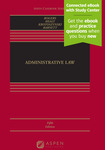
Administrative Law (Fifth Edition)
John Rogers, Michael Healy, Ronald J. Krotoszynski, and Kent H. Barnett
For instructors who prefer a case-oriented approach, the Fifth Edition of Administrative Law is a case-rich text that focuses on the core issues in administrative law. Lightly-edited cases preserve the feel of reading entire opinions and include facts, content, full analyses, and citations. Keystone cases introduce important themes and topics. Introductory material and questions following the cases focus students’ reading and stimulate class discussion, while helpful notes facilitate keen understanding of legal doctrines, introduce students to academic responses to judicial decisions and agency practices, and identify recent developments in doctrine and academic study. “Theory Applied” sections at the conclusion of major parts offer teachers an opportunity to evaluate students’ grasp of the materials in new factual and legal contexts. This flexible, easily teachable text is designed for a 3-unit course, and its self-contained parts can be taught in any order.
New to the Fifth Edition:
- Addition of important, recent U.S. Supreme Court and Circuit Court decisions throughout
- Extended discussion of “informal” agency adjudication
- Updated discussion of the nondelegation doctrine and its possible future
- Recent developments in judicial review, including with Kisor and Chevron deference and standing
-
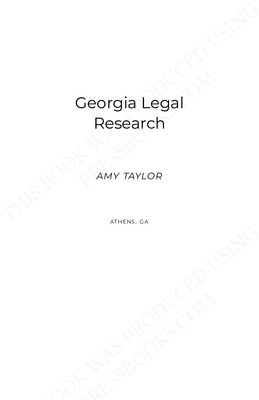
Georgia Legal Research
Amy Taylor
This open source textbook authored by Amy Taylor was designed to provide University of Georgia School of Law students with a comprehensive guide to Georgia legal research. Using this text in combination with appropriate assignments, student objectives include the ability to select, evaluate, and use appropriate legal research tools with an emphasis on cost-effective research and proficiency in the following topics:
- Developing an efficient and cost effective research strategy
- Advanced searching skills in legal research databases
- Case law, including docket research, court rules, and verdicts & settlements
- Statutory law, including legislative materials and legislative history
- Administrative regulations, rules, and related materials
- Practice materials, including litigation and transactional tools
- Competitive Intelligence & business information
- Local & municipal law
- Legal ethics
- Free and low cost internet legal resources
Attorneys use primary and secondary sources to research the law as it applies to a client’s legal situation in order to give accurate legal advice. A careful legal researcher asks critical questions of these sources and acknowledges the potential strengths and weaknesses of a client’s legal situation before giving legal advice.
-
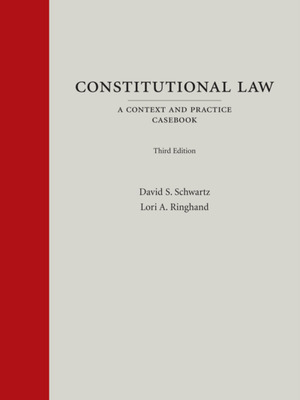
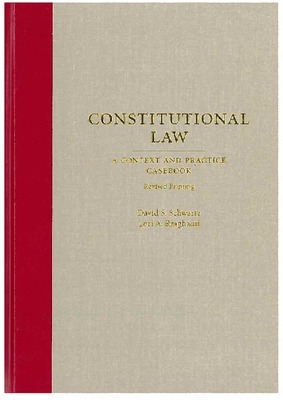
Constitutional Law: A Context and Practice Casebook (Third Edition)
David J. Schwartz and Lori A. Ringhand
The third edition of Constitutional Law: A Context and Practice Casebookreflects important recent developments in constitutional law and highlights newly contested areas, including issues involving freedom of speech and religion, executive powers and immunities, and the scope of congressional authority. As in prior editions, this unique casebook offers comprehensive coverage and allows you to teach constitutional law your own way, without having to fight the book. Using its unique electronic "Expansion Pack" system of supplemental modules available via a supplementary website maintained by the authors, you can customize your course while still following the book's structure.
That structure is streamlined into five parts of two chapters each, which cover all the essential doctrines of constitutional law. The book can be used for any general constitutional law course, whether offered in the first semester or later, and whether it covers governmental structure, individual rights, or both.
This book is part of the Context and Practice Series, edited by Michael Hunter Schwartz, Professor of Law and Dean of the McGeorge School of Law, University of the Pacific.
-
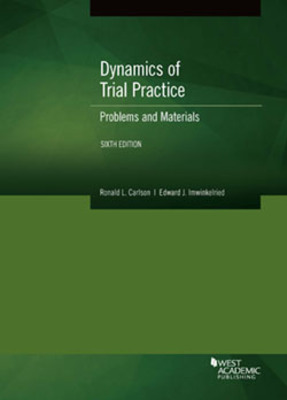
Carlson and Imwinkelried's Dynamics of Trial Practice, Problems and Materials (Sixth Edition
Ronald Carlson and Edward J. Imwinkelried
This trial practice book devotes an entire chapter to the concept of strategic case evaluation and integrates that concept into the discussion of every stage of the case. The text contains a large number of casefiles. In addition to the workplace sexual harassment, elder abuse, Munchausen Syndrome by Proxy, and civil rights/jail suicide contained in the fifth edition, the sixth edition includes casefiles for a Second Amendment civil rights case, a burglary prosecution, a dispute over the ownership of a dating website, and a homicide resulting from an encounter between a private citizen and a police officer. Each chapter now includes a PREVIEW and a REMINDER as pedagogic aids. At the beginning of each chapter, the PREVIEW alerts the students to the most important and challenging material in the chapter. Near the end of the chapter, the REMINDER poses questions to the students to enable them to determine whether they have grasped the key material in the chapter. The voir dire chapter has been reorganized to make it easier for students to use, and the chapters on direct and cross-examination on expert witnesses have been updated to reflect the most recent developments in expert testimony law, notably the growing importance of the PCAST concept of Validity as Applied.
-
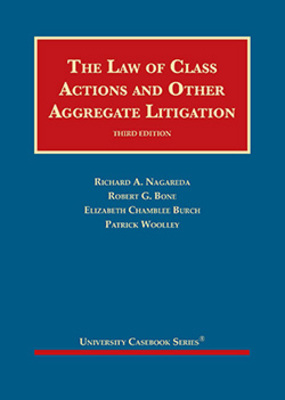
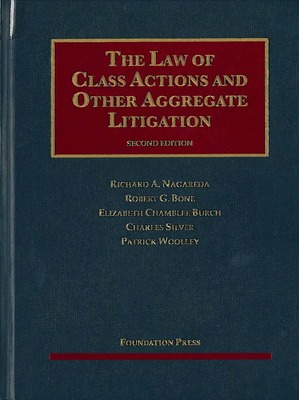
The Law of Class Actions and Other Aggregate Litigation (Third Edition)
Robert G. Bone, Elizabeth Chamblee Burch, Patrick Woolley, and Richard A. Nagareda
The third edition of this casebook reflects the many developments that have occurred in aggregate litigation since 2013 while continuing to treat the subject as a coherent whole. This edition includes a short, systematic introduction to the range of different aggregation techniques and then pays detailed attention to class actions, multidistrict litigation (MDL), parens-patriae suits, bankruptcy, and arbitration. In particular, this edition features a new chapter devoted to MDL, in which topics range from selecting the transferee court, choosing what law should apply, and exploring the judicial role in examining MDL’s effect on settlement and leadership selection. As before, the casebook does more than just present the law—it considers multiple perspectives on policy, litigation strategy, judicial practice, financial considerations, and empirical findings.
The book fills three gaps in the market for teaching materials on the U.S. civil justice system. First, it treats “aggregate litigation” as a cohesive field of law that encompasses all devices for processing claims en masse. Second, the book confronts forthrightly the reality of our civil justice system as one geared toward settlement, not trial. From this vantage point, the casebook sees the processes for aggregate litigation as vehicles through which to achieve comprehensive, or broadly encompassing, resolution of related civil claims. Third, the book frames the legitimacy of preclusion in aggregate litigation by drawing, among other things, on conceptions of legitimacy in other settings, such as private contract and public legislation. In so doing, the casebook encourages students to see cross-cutting connections with their other courses on such topics as contracts, corporations, and administrative law. -
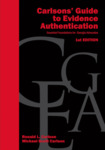
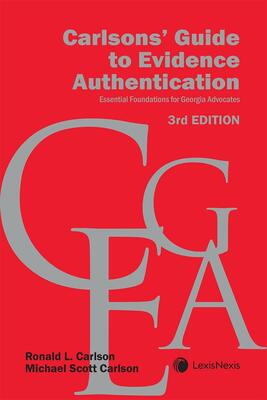
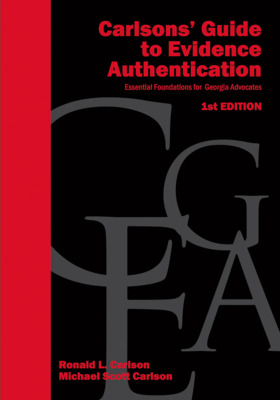
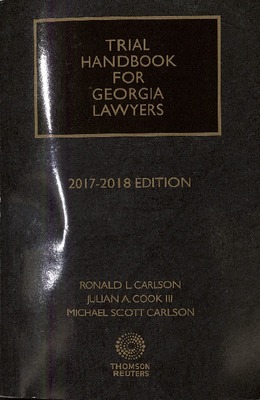
Carlsons' Guide to Evidence Authentication: Essential Foundations for Georgia Advocates
Ronald Carlson and Michael Scott Carlson
Shipping now, the new Carlsons’ Guide to Evidence Authentication is designed to go to court. The smaller counterpart to Carlson on Evidence features alphabetical organization, structure by key evidence terms, sample evidentiary foundations, and “Q&A’s”- for a host of evidence. It focuses on succinct analysis of crucial evidence concepts in “new” Georgia and Eleventh Circuit authority.
-
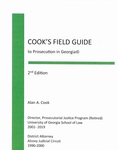
Cook's Field Guide to Prosecution in Georgia (Second Edition)
Alan A. Cook
Chapters cover topics ranging from the investigation and arrest of suspects to the questioning of suspects in custody, from the preliminary hearing to the drafting and presentation of indictments to the grand jury, from the arraignment and guilty plea to the sentencing hearing, and from discovery and motion hearings to the jury trial and appeal.
Special chapters address Ineffective Assistance of Counsel, the Identification of Suspects, Crawford & The Confrontation Clause, Search Warrants, Search Warrant Attacks, Well-Recognized Exceptions to the Search Warrant Requirement, and Ethics & Professionalism.
-
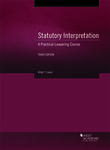
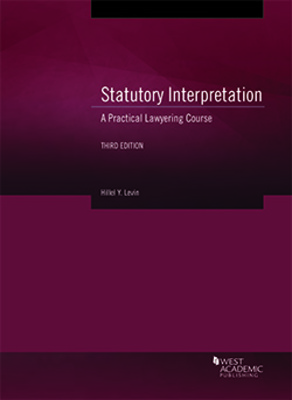
Levin's Statutory Interpretation: A Practical Lawyering Course (Third Edition)
Hillel Y. Levin
This book is for instructors of Statutory Interpretation and related courses who want to introduce practical lawyering skills into the doctrinal curriculum. It is also comparatively inexpensive for students. Much like any law school case book, Statutory Interpretation: A Practical Lawyering Coursecovers the leading cases; but it also offers much more. For example, it includes:
- interpretive exercises to concretize lessons and to help students to self-assess their learning;
- legislative negotiation and drafting exercises to give students practical experience and a deeper understanding of the complexities of the legislative process;
- lawyers' briefs and case documents to help students understand how cases and arguments are put together;
- case files and brief-writing exercises to teach students to craft arguments based on their doctrinal studies;
- exercises that require students to problem-solve, prompting them to think strategically;
- a mix of heavily-edited, lightly-edited, and unedited cases to help students prepare to work in the real world;
- issues and questions for students to focus on as they read cases and other materials.
-
Legal Writing Manual
Jean Mangan, Chase Lyndale, and Gabrielle Gravel
This manual provides you with an overview of first-year legal writing topics and provides checkpoints during your writing process. On the other hand, this manual does not answer every question you have ever had on any legal writing concept and it is certainly not a spellbook that will make you instantly awesome at legal writing. Writing as a skill is a lifelong development process. Everyone can be an effective legal writer. Put in the time to study the concepts and then to practice using those concepts in your writing. Seek feedback on your writing and implement the feedback you receive. Writing takes practice, and this manual can help guide you through.
This manual was produced with funding from University of Georgia’s Office of the Senior Vice President for Academic Affairs and Provost’s Affordable Materials Course Grant. This work is licensed under a CC BY-SA 4.0 license.
-
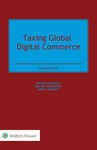
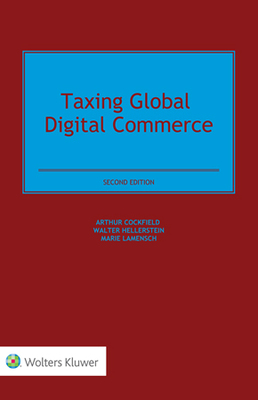
Taxing Global Digital Commerce (Second Edition)
Walter Hellerstein
Taxing Global Digital Commerce studies the tax challenges presented by cross-border digital commerce and reports on the rapidly changing environment surrounding the challenges. Digital commerce – the use of computer networks to facilitate transactions involving the production, distribution, sale, and delivery of goods and services – has grown from merely streamlining relations between consumer and business to a much more robust phenomenon embracing efficient business processes within a firm and between firms. Inevitably, the related taxation issues have grown as well. This latest edition of the preeminent text on the taxation of digital transactions revises, updates and expands the book’s coverage that reflects the significant changes that had been made to the content of the earlier volumes. It includes a detailed and up-to-date analysis of income tax and VAT developments regarding digital commerce under the Organisation for Economic Co-operation and Development and G20 Base Erosion and Profit Shifting (BEPS) reforms. It then explores the new EU VAT rules for both tangible and intangible Internet supplies and the implications of digital commerce for US state retail sales and use tax regimes, taking account of the significant developments resulting from the 2018 US Supreme Court decision in Wayfair.
What’s in this book:
Analysing the practical tax consequences of digital commerce from a multijurisdictional perspective and using examples to illustrate the application of different taxes to digital commerce transactions, the book offers in-depth treatment of such topics as the following:- how tax rules governing cross-border digital commerce are increasingly applied to all cross-border activities;
- how tax rules and institutional processes have evolved to confront challenges posed by digital commerce;
- how an emerging ‘tax war’ is developing whereby different countries are unilaterally imposing new direct tax rules on cross-border digital commerce;
- how digital commerce increases the complexity of implementing and enforcing the collection of VAT/GST in cross-border situations;
- how technology enhances cross-border tax information exchanges; and
- how technology reduces both compliance and enforcement costs.
The authors offer insightful views on the likely development of new approaches to taxing cross-border digital commerce and expand their focus beyond ‘law’ to undertake a more systematic study of tax law and technology change in the digital age, and they seek to to identify general policy lessons from their study of global and United States subnational rules.
How this will help you:
This edition, while building on the analysis of the relationship between traditional tax laws and the Internet in the previous editions, contains a more explicit and systematic consideration of digital commerce issues and the ongoing policy responses to them. As the world’s premier book on the topic of tax and digital commerce, this book will be welcomed by tax professionals and academics everywhere for the important contribution it makes towards the design of cross-border tax rules that are both conceptually sound and practical in application.
School of Law faculty at the University of Georgia author some of our country's leading legal scholarship. The following is a collection of books published by our past and current faculty members. Several faculty members have also created open educational resources made available through open textbook platforms. View a list of our faculty's open educational resource materials.
Printing is not supported at the primary Gallery Thumbnail page. Please first navigate to a specific Image before printing.